
A Safety Guide to Gorilla Charges in Bwindi
A Safety Guide to Gorilla Charges in Bwindi enables you to understand a few actions that may lead to gorilla charges and measures on how to overcome them during gorilla trekking. Arguably, mountain gorillas are an endangered type of forest species that share 98% of their DNA with humans. Even though they are closely related to humans, mountain gorillas are still untamed animals. Even though mountain gorillas are typically thought of as peaceful and kind creatures, this does not guarantee a safe trip, especially if you ignore the rules and regulations of the trekking activity.
Many visitors from across the world travel to Bwindi Impenetrable Forest National Park mainly to witness mountain gorillas in their native habitats, and they always hope for a successful safari, according to your safety guide to gorilla charges in Bwindi. However, this is not a certainty because you can find the gorillas hostile or think you pose a threat, particularly to the silverback, who is always in charge.
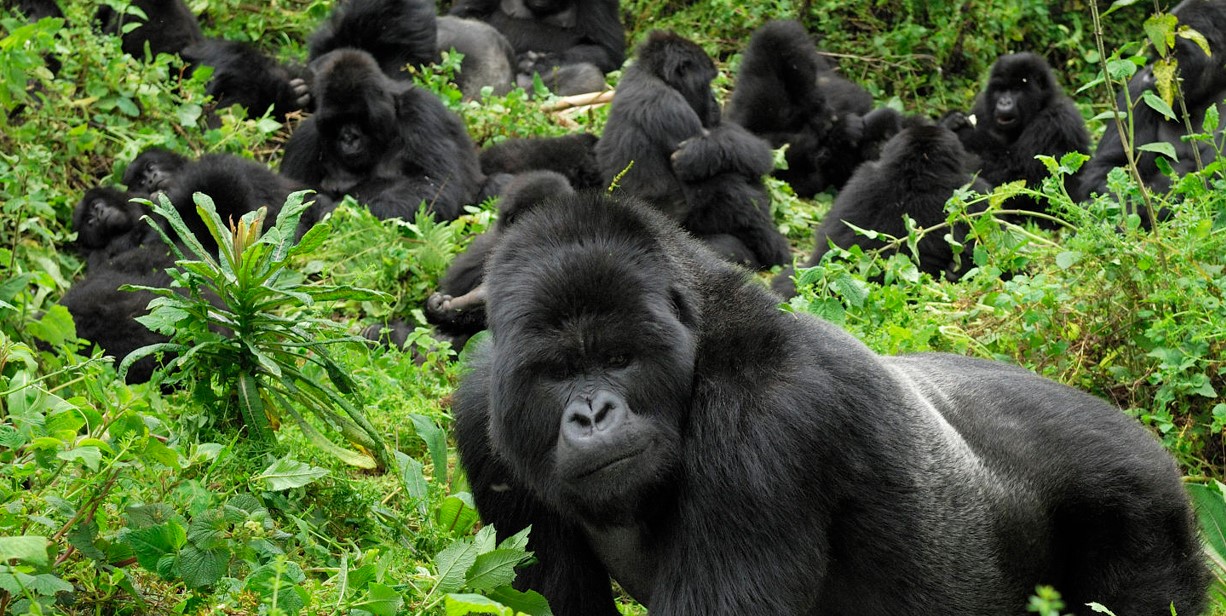
The dominant male, known as the silverback, is in full charge and watches over everyone and makes sure they are secure. A silverback will do everything it takes to protect its members when it perceives that human presence is a threat. When a silverback feels threatened, it will literally stand on its hind legs, pound its chest, hoot, and cry out loud to scare off an assailant. If the opponent does not back down, it can destroy and shatter plants.
A safety guide to gorilla charges in Bwindi Impenetrable Forest National Park
During gorilla trekking, there are a few actions that can result in a gorilla charge, regardless of whether you follow the rules and regulations of the trekking activity. We think there are two ways you can defend yourself when a gorilla attacks you.
Squatting down
When the mountain gorilla charges, armed ranger guides will advise you to squat, keep quiet, and show respect. If you crouch down, a mountain gorilla will see that you are gentle and will conclude that you are not there to hurt it. Furthermore, if you crouch on your knees, a mountain gorilla will feel you are not there to confront it and will back off, preventing an assault.
Always walk away steadily
In Bwindi, if a mountain gorilla charges at you, you should cautiously back off and not run. In Bwindi, you are not allowed to run away from a charging mountain gorilla because it would chase you in retaliation. If a mountain gorilla is pursuing you, there is a significant chance it may attack you. Just give the mountain gorilla plenty of room to relax by moving away from it.
Behave like a gorilla
As it charges, walk on four legs and act like a mountain gorilla. You should avoid looking it in the eyes, but you can break and pick leaves. Another option is to pretend that you are eating grass. If it sees you eating vegetation as it approaches you, it will just leave.
Gorilla Charge prevention tips
All you have to do is follow the gorilla trekking instructions given by park wardens at the briefing facility to avoid charging mountain gorillas in Bwindi. Before heading into the jungle to look for mountain gorillas, park wardens gather all participants and inform them of the many gorilla trekking rules and regulations that must be followed.
- Wearing bright colours like yellow, lemon green, or red while trekking is not advised.
- Keep your distance from mountain gorillas.
- When speaking near mountain gorillas, use very quiet voices.
- Use a camera without a torch for taking photos, and do not look a mountain gorilla in the eyes.
- Keep a distance of seven metres from mountain gorillas.
Reasons behind gorilla charging
Trekkers who move towards mountain gorillas carelessly may give the impression that they are attempting to harm them. Mountain gorillas would charge to scare off trekkers for this reason, hence one of the reasons behind gorilla charging.
When you use a camera with a torch to take pictures of mountain gorillas, they charge. Your local tour operator will advise you to carry a camera without a flash, or you will be informed at the briefing centre.
Mountain gorillas will attack if a silverback or a lone gorilla from another group tries to take members of the family or subjugate them. The mountain gorillas charge, often leading to fights, to scare it or prevent it from capturing group members.
Mountain gorillas have the capacity to charge when they see hikers after a prolonged absence. Because they eventually lose their ability to adapt to human presence and start to view hikers as enemies, a family of habituated mountain gorillas may charge.
Among other reasons behind gorilla charging include: looking into the eyes of the gorillas might make them uncomfortable and cause them to become aggressive. Because mountain gorillas are more likely to charge when you make noise, visitors are urged to speak very quietly when around them during the sector offices’ briefing.
Mountain gorillas may still charge at you even if you follow the rules for the trekking activity. If you forget the safety precautions they taught you at the briefing centre, your armed ranger guides will always give you advice on what to do.
Conclusion
Every tourist would like to take part in mountain gorilla trekking—a once-in-a-lifetime opportunity to see mountain gorillas in their native habitats. Buhoma, Nkuringo, Ruhija, and Rushaga are the locations where mountain gorillas can be observed in the Bwindi Impenetrable Forest National Park. The world’s highest concentration of mountain gorillas is found in these hiking zones together.