
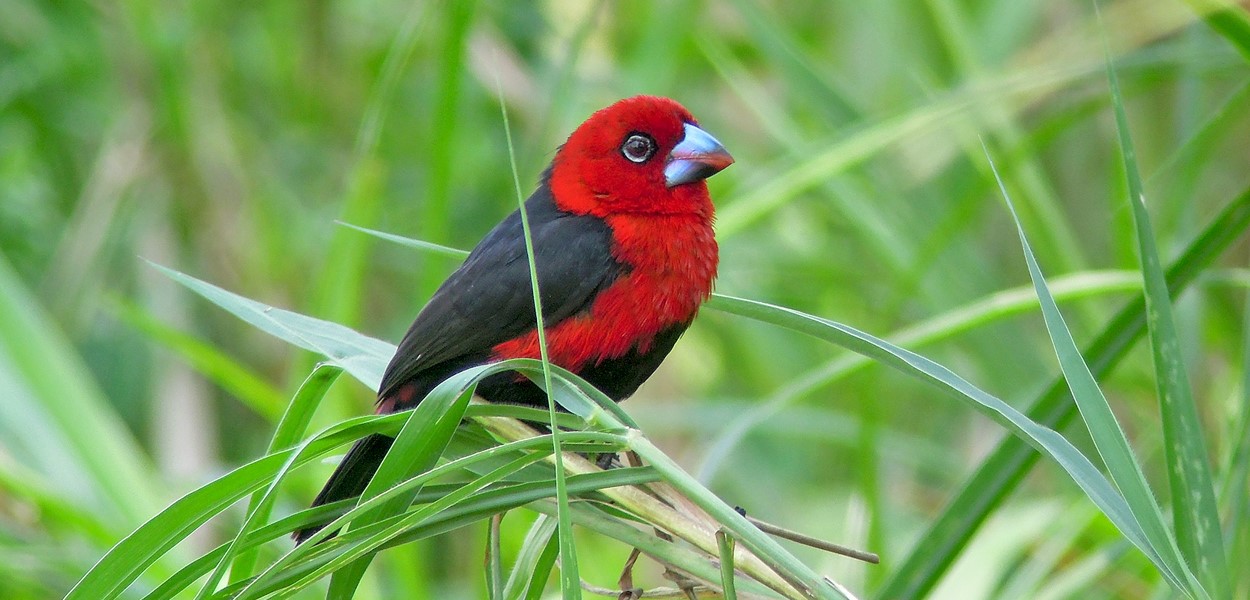
The Red-headed Bluebill in Uganda
The Red-headed Bluebill in Uganda: Native to Africa, the Red-headed Bluebill (Spermophaga ruficapilla) is a fascinating species that is particularly prominent in Ugandan avifauna. In addition to being of ornithological significance, the Red-headed Bluebill is an essential part of Uganda’s rich biodiversity because of its remarkable plumage, unique behaviour, and vital role in the ecosystem. The habitat, lifestyle, eating habits, conservation status, and overall ecological value of the Red-headed Bluebill in Uganda are examined in this article.
The Red-headed Bluebill is a member of the Estrildidae family, which includes a wide variety of finches that are frequently found in Africa. Its bright red head, which contrasts with its deep blue body, and its characteristic yellow underparts make this species easy to identify. Adult males have the brightest colouring, whereas females have a more muted colour scheme, reflecting a frequent sexual dimorphism in many birds.
Habitat and Distribution
Uganda is a key location for the Red-headed Bluebill’s population, which is primarily found in the tropical forests and dense thickets of Central and East Africa. The bird prefers locations near rivers, swamps, and rainforests because it thrives in moist, humid settings. Well-preserved reserves like Kibale National Park and Bwindi Impenetrable National Park in Uganda are home to sizable populations, where the abundant flora and fauna offer plenty of chances for foraging and nesting.
Frequently seen darting through the underbrush, the Red-headed Bluebill uses its nimble flying to get through the tangled ground cover. Given that the bird’s survival is seriously threatened by habitat fragmentation and deforestation, its capacity to adapt to different forest strata emphasises the value of protecting its natural habitat.
Behaviour and Feeding Patterns
The Red-headed Bluebill’s numerous habits demonstrate how well it adapts to its surroundings. Usually observed in small groups, these birds frequently coexist with other estrildid species. Their social organisation is marked by a high degree of interaction, which is necessary for foraging and communication.
The Red-headed Bluebill, which mostly eats seeds, fruits, and insects, is an important member of the ecology because it helps spread seeds. The beak of the bird is specially designed to effectively break seeds, which promotes the growth of many plant species. The complex interaction between the Red-headed Bluebill and its habitat is shown by observations that show a preference for the seeds of grasses and other herbaceous plants.
The start of Uganda’s rainy season, which normally lasts from March to May and again from September to November, coincides with the Red-headed Bluebill’s breeding season. Because dense vegetation provides refuge from predators, nesting typically takes place there. The female is quite diligent in building the nest, frequently using feathers, grass, and leaves.
Both parents take part in the incubation process and provide care for the newborns, which usually yields clutches of four to six eggs. Approximately two weeks after hatching, the young shoots leave the nest and are quickly taught foraging techniques by their parents to ensure their survival in the wild. This caring behaviour is essential to maintaining the species’ survival.
Because of its wide range and rather consistent population size, the Red-headed Bluebill is listed as a species of least concern by the International Union for Conservation of Nature (IUCN). However, several reasons, most notably habitat degradation brought on by logging, agricultural expansion, and urbanisation, continue to endanger the species. Increased deforestation in Uganda poses a serious threat to the Red-headed Bluebill’s and many other bird species’ natural habitats.
For this species to survive, conservation initiatives that prioritise protecting Uganda’s forests are essential. Organisations devoted to conserving Uganda’s biodiversity put up endless efforts to encourage environmentally friendly behaviours, increase public knowledge of the ecological importance of bird species, and include local populations in conservation projects.
The overall condition of the forest ecosystem is reflected by the Red-headed Bluebill, which acts as an indicator species. Populations of this bird in good health indicate a sustainable and functional ecosystem, which is necessary for many other plants and animals. Bird watchers, scientists, and ecotourists are drawn to this species, which increases interest in wildlife protection and boosts the local economy.
In conclusion, we take important steps towards protecting Uganda’s exceptional biodiversity for future generations by recognising the Red-headed Bluebill’s environmental significance and supporting conservation initiatives. This bird’s magnificent presence highlights the value of ongoing efforts to preserve Uganda’s rich natural heritage and is a testament to the craftsmanship of nature.
What are the best places to see the Red-headed Bluebill in Uganda?
The remarkable Red-headed Bluebill, a species that is eagerly sought after by birdwatchers, is one of Uganda’s avian wonders, which are known for their biodiversity. There are a few places that are particularly noteworthy for seeing this fascinating bird in its natural environment. The Red-headed Bluebill flourishes in the thick vegetation along the water’s edge, making the pristine wetlands of the Mabamba Swamp, close to Lake Victoria, an excellent place to see it. Semuliki National Park is another excellent destination to see the Red-headed Bluebill
Additionally, birdwatchers have the chance to see this rare species among the rich vegetation of Bwindi Impenetrable National Park’s thick forests. In a similar vein, the vast wetlands of the Albert Nile and the borders of Queen Elizabeth National Park are acknowledged as ideal locations for witnessing the Red-headed Bluebill’s vivid plumage and unique habits. These sites offer an immersive experience in Uganda’s many ecosystems in addition to increasing the possibility of sightings.